
https://www.thehindubusinessline.com/books/rethinking-the-way-we-decide/article70848510.ece
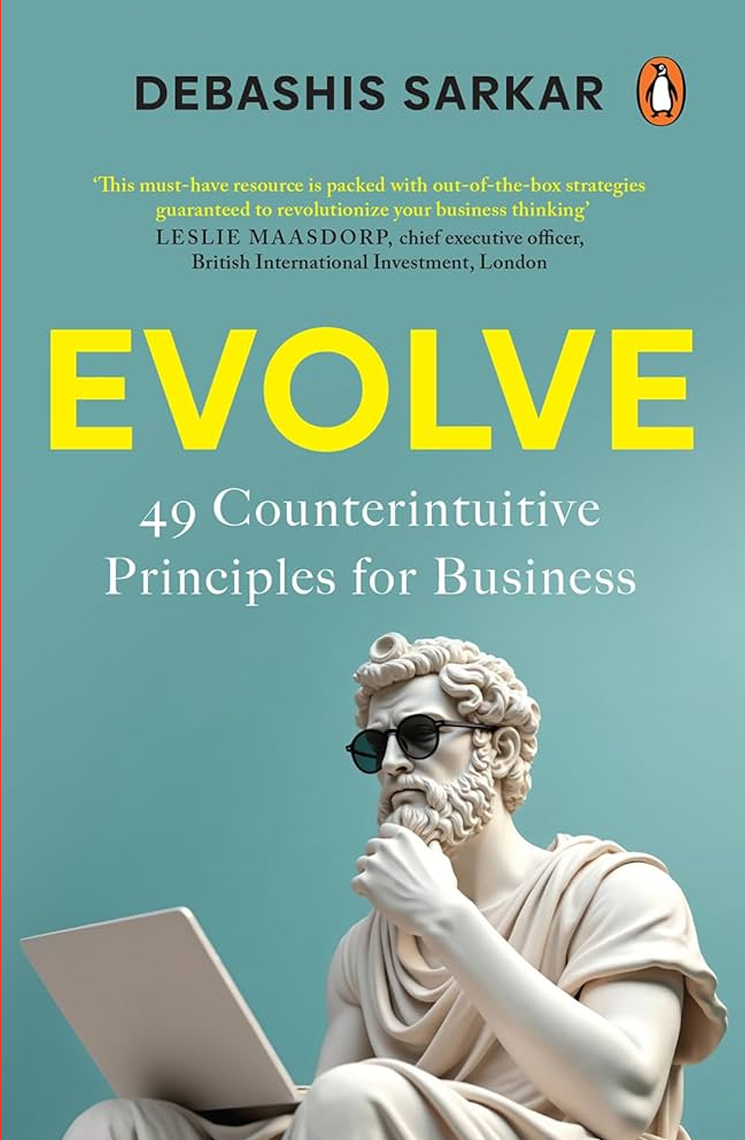
In a business environment where speed is often equated with effectiveness, Evolve: 49 Counterintuitive Principles for Business by Debashis Sarkar offers a timely reminder: progress is not just about moving faster, but about seeing more clearly.
This is not a conventional business book that provides a set of frameworks or step-by-step solutions. Instead, it challenges the way we think about problems in the first place. It shifts the focus from “What should we do next?” to a more fundamental question“How are we looking at the situation to begin with?”
At its core, the book brings together 49 principles drawn from fields such as psychology, economics, behavioural science, and systems thinking. While this may appear to be a broad compilation, what stands out is the structure. Of the 49 principles, close to 30 are articulated as laws, 10-12 as paradoxes, and the remaining 5-7 as effects, biases, and fallacies.
These principles are presented as a combination of laws, paradoxes, and biases, each category playing a distinct role. Laws help us understand predictable patterns in systems and behaviour. Paradoxes challenge our assumptions and reveal that outcomes are not always linear or intuitive. Biases and fallacies, on the other hand, explain why even experienced individuals can misinterpret situations despite having access to information.
Together, they create a layered way of thinking, one that goes beyond surface-level problem-solving. This interplay between structure, contradiction, and human limitation makes the book particularly relevant in today’s complex and fast-changing world, where decisions are rarely straightforward and clarity often depends on perspective as much as information.
One of the early ideas emphasises the value of diverse perspectives in problem-solving. When individuals with different experiences and viewpoints come together, the likelihood of identifying blind spots reduces significantly. In practical terms, this reinforces the importance of collaboration not just within teams, but also with external stakeholders who can offer fresh insights.
Another key insight relates to performance under pressure. The relationship between stress and effectiveness is not straightforward. While a moderate level of challenge can improve focus and productivity, excessive pressure can lead to anxiety and reduced performance. This has implications not only for leaders managing teams, but also for individuals navigating demanding environments.
Making decisions
The book also highlights a challenge that many of us encounter in daily life — the difficulty of making decisions when faced with too many options. As choices increase, decision-making becomes slower and more complex. Whether it is selecting a product, designing a service, or making a strategic decision, simplicity often leads to better outcomes than overwhelming abundance.
Another interesting observation is how contributions within teams are often uneven. A relatively small group tends to account for a significant portion of results. This insight encourages a closer look at how work is distributed, how talent is nurtured, and how organisations recognise performance.
On the behavioural side, the book offers explanations for patterns many of us recognise but rarely analyse. For instance, motivation tends to increase as we get closer to achieving a goal. This is why visible progress such as tracking completion or milestones can significantly improve engagement.
Similarly, the tendency to delay difficult tasks in favour of easier, immediately rewarding ones is not simply a matter of discipline. It reflects a natural human inclination towards short-term comfort. Understanding this can help individuals and organisations design work in a way that encourages better follow-through.
A particularly relevant idea in today’s context is the gap between the pace of technological change and the speed at which organisations adapt. Technology continues to evolve rapidly, while organisational processes and behaviours tend to change more gradually. This mismatch often explains why transformation efforts face resistance or fall short of expectations.
Where the book becomes especially thought-provoking is in its discussion of paradoxes, ideas that go against intuitive thinking. For example, improving efficiency does not always reduce consumption; in some cases, it can lead to increased usage. Likewise, what appears effortless is often the result of consistent effort over time.
On the interpersonal front, the book offers a simple yet powerful reminder: not every action should be interpreted as intentional or negative. Many misunderstandings arise from incomplete information rather than deliberate intent. A shift in perspective can often improve both communication and collaboration.
The discussion on cognitive biases further reinforces this point. People often rely on visible or immediate information while overlooking broader patterns and probabilities. This can lead to decisions that feel convincing in the moment but may not hold up under deeper scrutiny. Taking a step back to consider the larger context can help avoid such pitfalls.
What makes Evolve stand out is that it does not attempt to simplify complexity into neat formulas. Instead, it encourages reflection. Each principle acts as a prompt — an invitation to pause, question assumptions, and look at situations from a different angle.
Takeaways
Better decisions begin with better perspectives: Expanding how we view a problem often leads to more effective solutions.
Balance matters more than intensity: Whether in stress, effort, or choice, extremes tend to reduce effectiveness.
Awareness reduces error: Recognising patterns and biases can significantly improve judgment and outcomes.
Ultimately, Evolve feels less like a manual and more like a guide to thinking. It does not offer quick answers, but it builds the ability to ask better questions.
In a world where complexity is increasing and decisions carry greater consequences, that may be its most valuable contribution. Because success in business and in life is not only about doing more or doing better. It is about seeing more clearly.
The reviewer is a certified leadership coach and writes on human-centric leadership models